ARCHIMEDES BEAVER

ABOUT BEING BUSY.

Sunday, September 15, 2019

Saltwater Beavers


swimming beaver

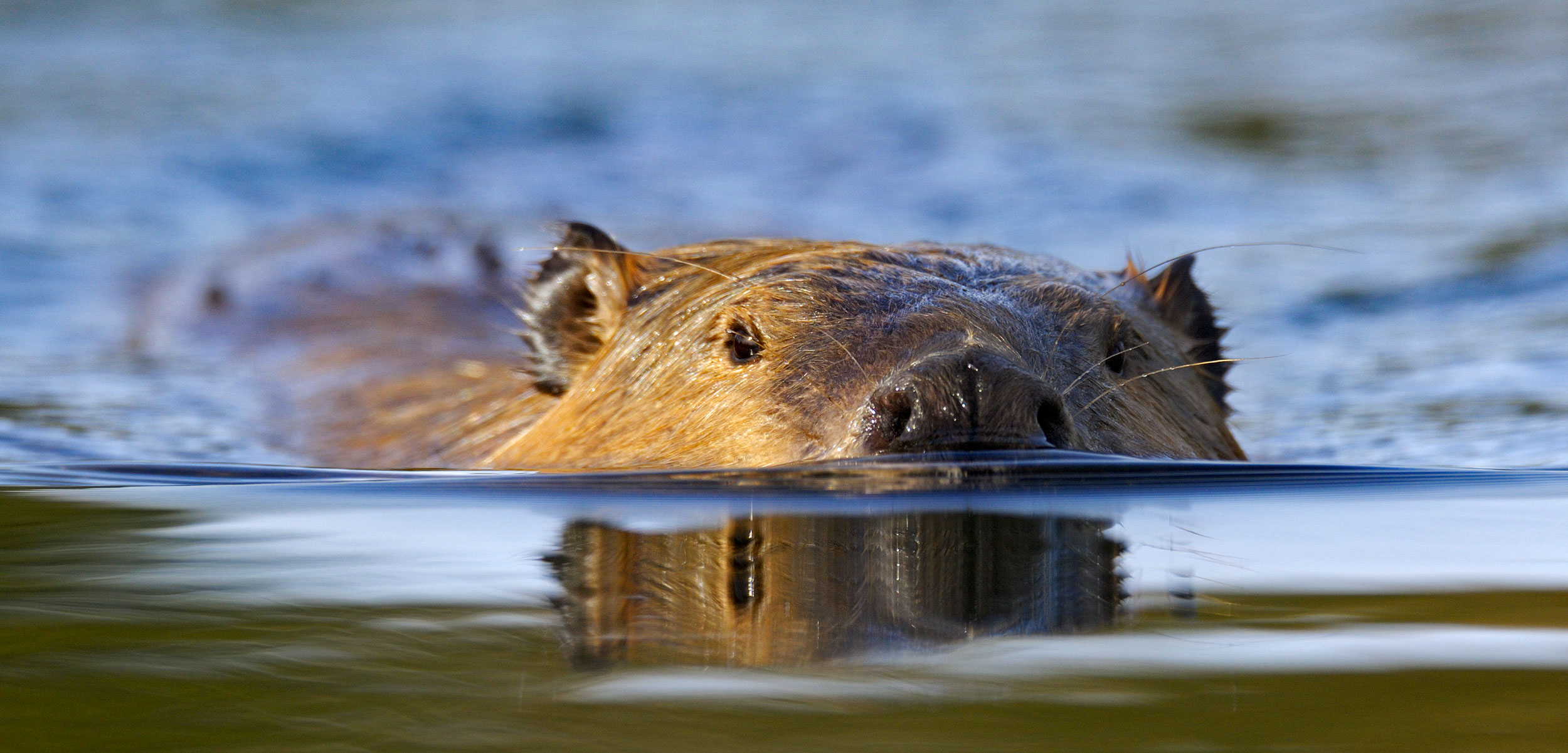
Most people associate the beaver, Castor canadensis, with fresh water—but it’s a coastal creature too. 
Photo by George Sanker/NPL/Minden Pictures

Scientists have long overlooked beavers in the intertidal zone. Now they’re counting on the freshwater rodents to restore Washington’s coastal ecosystems.


Hakai Magazine
@hakaimagazine


The Gnawing Question of Saltwater Beavers


Coastal science and societies


Videos + Visuals
Youtube


Most people associate the beaver, Castor canadensis, with fresh water—but it’s a coastal creature too. Photo by George Sanker/NPL/Minden Pictures
The Gnawing Question of Saltwater Beavers
Scientists have long overlooked beavers in the intertidal zone. Now they’re counting on the freshwater rodents to restore Washington’s coastal ecosystems.
Authored by
by Ben Goldfarb
Wordcount
January 29, 2019 | 3,000 words, about 15 minutes
Share this article


Stream or download audio For this article

This article is also available in audio format. Listen now, download, or subscribe to “Hakai Magazine Audio Edition” through your favorite podcast app.
Article body copy

The female beaver laying on a table in the exam room was nearly comatose, her whiskered face and nimble paws twitching with seizures. Bethany Groves, the attending wildlife veterinarian, had seen beavers before, many the victims of car strikes and dog attacks. Those patients tended to be feisty, snapping their orange, self-sharpening incisors—fortified with iron—at Groves’s hands. This 16-kilogram adult, though, had none of the species’ usual vigor. Within a day, the animal was dead.

Groves found a clue to the beaver’s demise in the circumstances of its death. Castor canadensis is, of course, a freshwater dweller, adapted to lakes and rivers and wetlands. Yet wildlife control officers had found this particular rodent rolling listlessly in the surf near a ferry terminal along the coast of Puget Sound, an inlet along the coast of Washington State.

On a hunch, Groves, who works for the Progressive Animal Welfare Society’s Wildlife Rehabilitation Center just outside Seattle, drew a blood sample. The beaver’s sodium level was a shocking 183 milliequivalents per liter, far above the normal concentration, typically 130 to 150 milliequivalents per liter. The animal, she suspected, had ingested enough seawater to induce salt toxicity.

One salt-poisoned animal might be dismissed as a lone misguided mariner. Since that February 2016 case, however, Groves has seen four more sick saltwater beavers. Each one has suffered the same symptoms—lethargy, seizures, and catastrophic sodium levels—and none has survived more than 24 hours.

“They’re found on the shoreline, often covered in sand—they literally look like they were just pulled out of the ocean,” Groves says. She has started IV drips on her paddle-tailed patients, attempting to rebalance their salt levels without success. Groves has preserved tissue samples from all five victims in formalin; when she reaches a half-dozen, she plans to send them to a pathology lab, which, she hopes, will confirm her diagnosis of salt toxicity. “The pathologist gets samples submitted from all over the world, yet this was totally unheard of to him,” she says.

Once hunted almost to extinction for hat-making, beavers are now found in lakes across North America. Development of their coastal habitat, however, has mostly erased beavers from the intertidal zone. Video by Pond5

Groves’s experience sheds some light on a curious phenomenon—that North America’s most iconic freshwater rodents frequently take to the ocean. Although the peer-reviewed literature is scant, there are many anecdotal accounts of brave beavers venturing to sea. After the Argentine government attempted to jump-start a fur trapping industry by introducing the rodents to Tierra del Fuego in 1946, for instance, beavers swiftly spread throughout the archipelago, eventually crossing the Strait of Magellan to the Patagonian mainland—a voyage of at least 2.4 kilometers. On Isle au Haut, 11 kilometers off the Maine coast, rangers captured photos of a bedraggled beaver in 2014.

Yet beavers aren’t just coastal wanderers, they’re also residents—potential health consequences be damned. Greg Hood, senior research scientist at the Skagit River System Cooperative in Washington, says biologists have overlooked beavers in the state’s tidal shrublands, a liminal zone washed twice daily by the ocean. Until recently, Hood adds, estuarine beavers were considered bizarre anomalies, when they were considered at all. “You don’t find what you don’t look for,” he says.

In freshwater environs, the dam builders are the ultimate keystone species, their ponds and wetlands furnishing habitat for creatures from mink frogs to wood ducks to moose. Hood’s research suggests beavers are equally indispensable along the coast, engineering deep pools for fish, including juvenile salmon, in estuaries plagued by habitat loss. Acknowledging the importance—indeed the existence—of coastal beavers might just be vital to re-creating a lost intertidal world: an ecosystem sculpted by rodent teeth, undone by human hands.

Among the best places to encounter coastal castors is the Qwuloolt estuary, the salt marsh that lies at the mouth of the Snohomish River, a 32-kilometer watercourse that wends from the Cascade mountains through verdant Puget Sound bottomlands. One summer morning, I kayak through the estuary with David Bailey, a biologist with the Tulalip Tribes, a Native sovereignty whose 8,900-hectare reservation lies just up the coast. Bailey and I paddle upstream against the outgoing tide, the air salty and rotten on my tongue. The endless flats are somber and ashen, pierced by skeletal spruces that tower over the plain like giant chess pieces.

Bailey works on the Tulalip Beaver Project, capturing troublemaking rodents around the greater Seattle area and relocating them to federal lands. Yet he and Molly Alves, a wildlife biologist with the Tribes, first encountered intertidal beavers in the Qwuloolt entirely by accident while conducting early-morning bird surveys. Beavers have since haunted the scientists’ visits to the estuary, often shattering its serenity with gunshot-like tail slaps, their signature alarm signals. “They’ll scare me half to death,” Bailey grumbles, dipping his paddle.
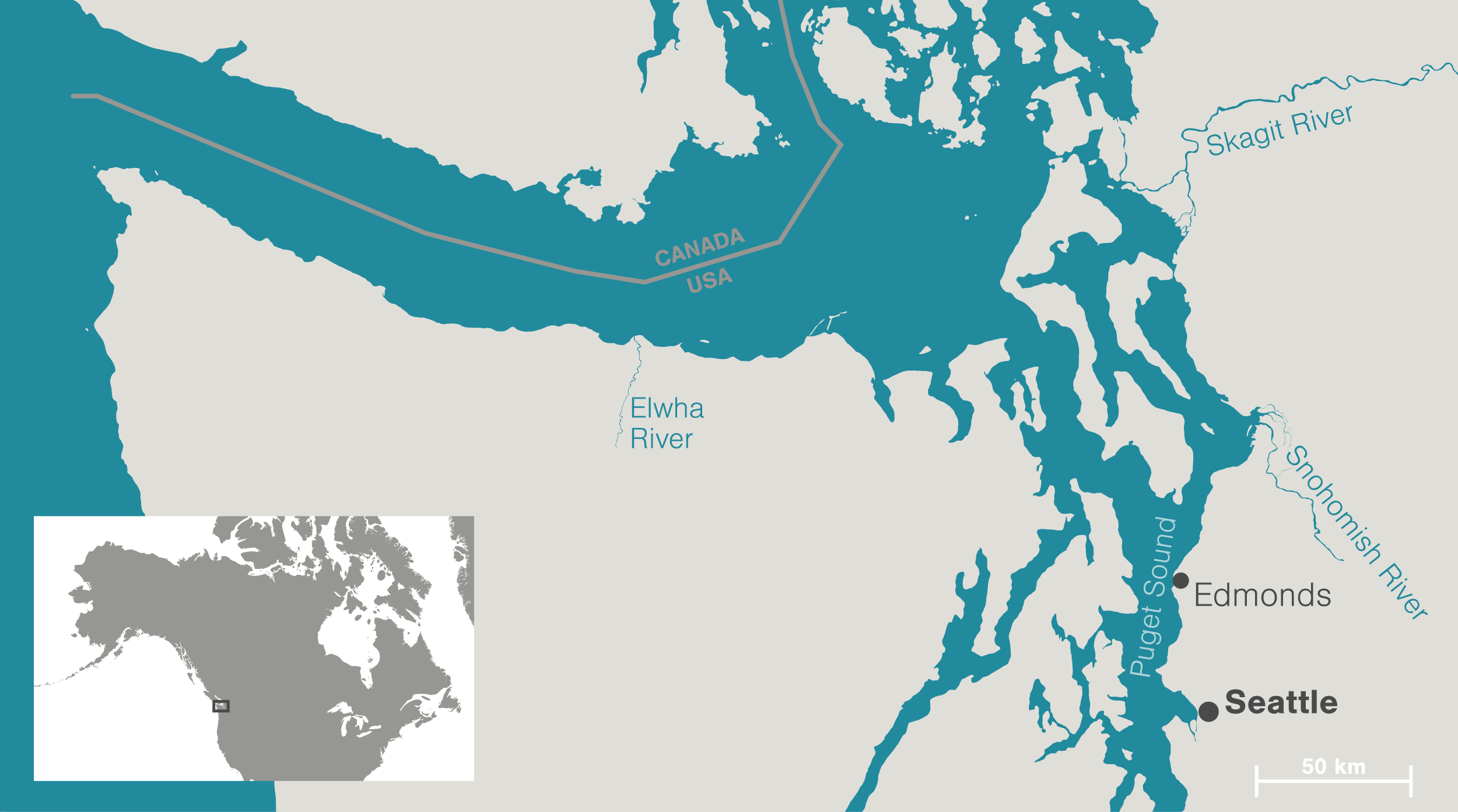

Illustration by Mark Garrison

After 15 minutes, we arrive at a channel, a thin seep of fresh water that courses down to the estuary through a gash in the floodplain. We pull onto the wedge of gloop that passes for a beach and clamber from our kayaks. I immediately sink mid-thigh in the slop, where, despite vigorous thrashing, I remain, a mammoth trapped in the La Brea tar pits. With a mighty lunge, I fall forward, shedding my mud-cemented waders like a chrysalis. Now shoeless and stripped to jeans, I lie down to distribute my weight across the jello-ish ground and flop, pinniped-style, onto a stable tuft of marsh grass. An osprey taunts me with a whistle.

“That’s probably why nobody studies these beavers,” Bailey quips from the safety of high ground. “Because it sucks.”

We slog up the steep-sided channel, slop oozing through my socks with each difficult step, into the tidal shrub zone—the narrow band of estuarine habitat that’s elevated just enough to sustain woody plants like willows but too soggy to support most large trees. At last we reach the beavers’ stronghold. I am underwhelmed. A ramshackle dam of sticks and mud, perhaps two meters wide, spans a trickle of murky water. Behind it swirls a stagnant pool clotted with algae. Compared with majestic beaver-built bulwarks I’ve seen elsewhere, it’s a sad specimen.

What this dam lacks in aesthetics, however, it makes up for in hydraulic brilliance. With the tide out, Bailey explains, this dam holds back water that would otherwise run to the sea, forming a deep bathtub in which beavers shelter from black bears and coyotes. Come back six hours later, and the returning tide will have filled this channel, completely submerging the dam. “You could kayak right over the top of it and not even know it was there,” Bailey says.

In other words, the estuary’s beavers seem to anticipate tidal fluctuations, erecting their dams in places that ensure water remains even when the tide reaches its ebb. The US Army Corps of Engineers could hardly have done it better.


David Bailey, a biologist with the Tulalip Tribes, stands next to a beaver dam exposed at low tide on the Snohomish River in Washington State. Photo by Ben Goldfarb

We wander the floodplain’s labyrinthine channels, fighting through tangles of wild rose that shred my socks and slash my forearms—and serve as Fort Beaver’s defenses. Burrows and dens riddle the banks, their entrances barricaded with microdams: stick piles, cemented with mud, perhaps intended to keep the tunnels inundated during low tide and thus impenetrable to intruders.

“It’s almost like they’re engaging different areas of the estuary at different tidal levels,” Bailey marvels. “It’s a whole multistory housing complex.” At the complex’s hub is the main lodge, excavated beneath the arched roots of a dying spruce and capped with a mound of dried sedge. The elaborate compound recalls an ant or termite colony—the sophisticated development of an inscrutable intelligence. Though I’m none too pleased with my muddy, shoeless condition, I have to admit I’m impressed with the beavers’ ingenuity.

What little we know about the architecture of intertidal beavers we owe to Greg Hood.

Hood works on the Skagit, a river that, like the Snohomish, spills from the Cascades to Puget Sound, relaxing into a broad estuary carpeted in willow, sweet gale, and wild rose. Like Bailey, Hood stumbled upon intertidal beavers while studying something else entirely: the role of downed logs in the Skagit ecosystem. The delta’s channels, Hood noticed in the mid-2000s, were chockablock with beaver dams and lodges. Beavers? In the intertidal? Hood reviewed the literature and confirmed his suspicions: estuarine beavers had escaped scientific attention.

Only humans rival beavers when it comes to engineering prowess. Video by Pond5

Hood decided to fill the gap. He surveyed 25 kilometers of Skagit tidal shrublands, bushwhacking through mud and brush so thick that he often located lodges only by stepping on them. The exhausting, mucky research was worth the trouble. Altogether, Hood found 125 beaver dams and 14 lodges, construction densities that rival most rivers. Beavers were thriving where no prior scientist had thought to look for them.

By engineering the intertidal to their own satisfaction, Hood discovered, the keystone rodents were sustaining other coastal residents as well. When he dragged seine nets through their pools, he found them teeming with stickleback, prickly sculpin, lamprey, and juvenile chinook salmon. At low tide, when receding waters would otherwise have flushed baby salmon toward waiting mergansers and kingfishers, Hood counted over three times more chinook in beaver pools than in other channels, suggesting that young fish were sheltering in beaver-built pockets until high tide submerged the marsh once more. Indeed, predatory great blue herons seemed to avoid beavery spots, where deep water and dense shrubs thwarted the broad-winged wading birds.

“The dammed areas can be over a meter deep at low tide, whereas the water might be just an inch or two deep in channels that aren’t dammed,” Hood explains. To vulnerable fish, beavers were serving as generous landlords, furnishing rent-free tidal refuges.
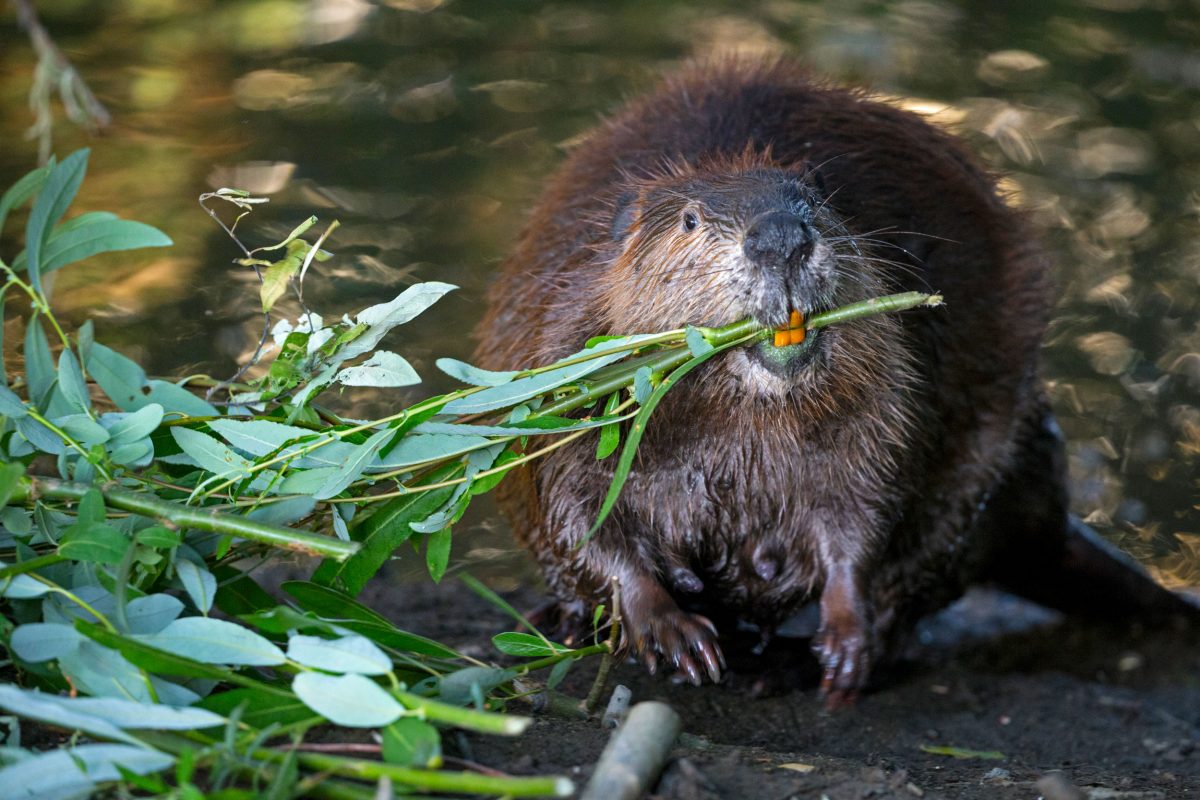


Beavers’ diets consist of the inner bark of trees such as willow (above), as well as cottonwood, aspen, alder, and other deciduous species. Photo by Suzi Eszterhas/Minden Pictures


When, in 2012, Hood published a paper describing the intertidal beaver phenomenon, the scientific community took surprised note. Colleagues who had previously ignored beavers now told him about sightings along the Oregon coast, the Columbia River estuary, and other Puget Sound tidal marshes. But if awareness is truly spreading, it’s moving slowly. “I’ll get calls from the Port of Tacoma being like, ‘Uh, why is this beaver swimming in Puget Sound?’” says Molly Alves from the Tulalip Tribes. “‘Is something wrong with him?’”

Maybe. Hood’s discovery that C. canadensis is shockingly prolific in the intertidal zone is tough to square with the rodents evidently killed by gulping seawater. How is it that some beavers flourish on the coast while others perish? Perhaps estuarine beavers typically dwell close enough to river mouths to access fresh water but occasionally stray too far to sea while dispersing between rivers, like foolhardy Icaruses of the intertidal. Or maybe some individuals are simply more salt-tolerant than others.

“How do these beavers cope with the salt water around them?” wonders Bethany Groves, the wildlife vet. “We just don’t know enough about their physiology yet to know.”

A week after my slog through the Snohomish, I head to the Olympic Peninsula for a more leisurely beaver tour with Anne Shaffer, director of the Coastal Watershed Institute—one of the few groups to champion the cause of coastal castorids. I meet Shaffer and her husband, David Parks, a hydrogeologist with the Washington State Department of Natural Resources, near the mouth of the Elwha River. We stroll alongside a brackish off-channel pond wreathed in morning fog, a beaver lodge erupting from its center like a volcanic island. A dark-sand beach divides the pond from the Juan de Fuca Strait, where clouds of western gulls snatch herring and smelt. “Looks like there’s quite the smorgasbord out there,” says Parks, gazing to sea.

Our attention this morning, however, is directed to the intertidal zone. Veering west, we squelch onto a floodplain lightly forested in alders, their trunks inscribed with beaver scars. Stands of willows, a beaver delicacy, have been whittled to stakes. The Elwha’s wooded floodplain is veined with channels, their banks pocked with beaver-dug burrows below the waterline. Salmon fry flee into the tunnels’ dark entrances at our approach. A few untidy dams interrupt one narrow canal. I ask Shaffer if the beavers built the structures to maintain deep water at low tide, as they do in the Skagit.

“I’d assume so,” she says, laughing. “You’d have to ask the beavers.”

Beavers busy in the intertidal zone create habitat for other species, including salmon, steelhead trout, and other fish. Video courtesy of the Coastal Watershed Institute

That beavers are sculpting this nearshore habitat is among Shaffer’s greatest joys. Shaffer, Parks, and a few others founded the Coastal Watershed Institute in 1996 to advocate for the protection and study of the Olympic Peninsula’s northern shoreline, which lies beyond the jurisdiction of Olympic National Park. At the time, the Elwha’s nearshore was a ghost of itself. Two gargantuan dams, the Elwha Dam and the Glines Canyon Dam, had trapped sediment upriver for decades, starving the estuary of silt and sand. The few walkers who visited the Elwha’s mouth found only forbidding, wave-blasted cobble.

In 2001, the US government, in response to pressure from the Lower Elwha Klallam Tribe, purchased the dams with the intent of blowing them up—the largest dam removal project in history. To Shaffer’s dismay, none of the project’s designers seemed much interested in the coastline. The demolition’s budget funded biological research around the old reservoir sites, but neglected to allocate money for studying the nearshore, eight kilometers distant. At planning meetings, Shaffer often found herself last on the agenda. “I’d be talking to people as they were walking out the door for their lunch break,” she says.

When, in 2011, the government began blasting away the dams, Shaffer was instantly vindicated. As the reservoirs drained, millions of cubic meters of mocha-colored sediment raced downstream, settling at the river’s mouth. With the Elwha freed, a 40-hectare wedge of beaches, sandbars, and floodplains reemerged—a coastal kingdom built by silt. “Few people are excited to see a big pile of sand,” the Seattle Times reported, “unless it’s a big pile of sand at the mouth of the Elwha River.”
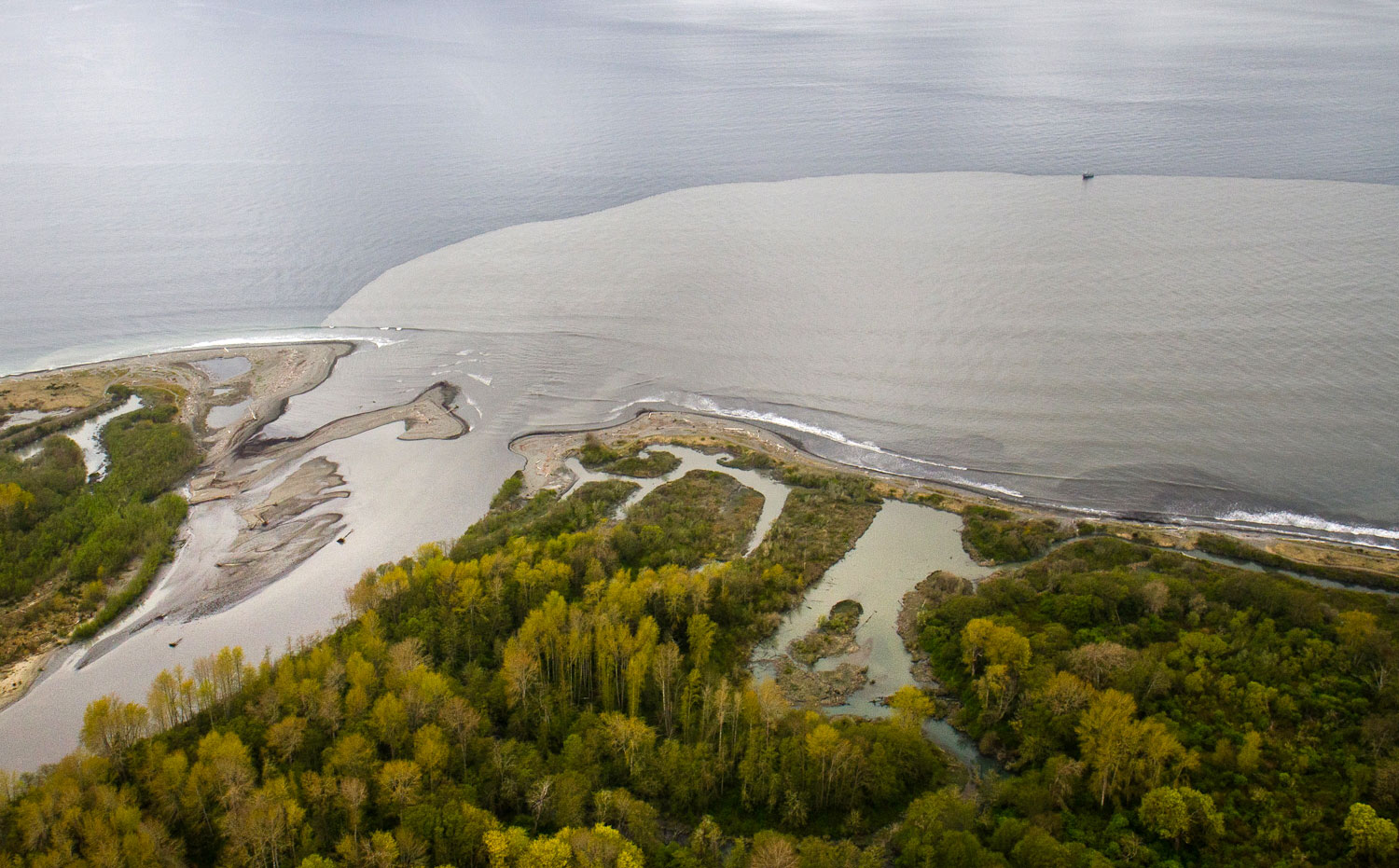


Elwha River sediment mixes with the coastal waters of the Juan de Fuca Strait in Washington State. Photo by John Felis/USGS

No one was more excited about the big sand pile than the Elwha’s beavers. The river’s beavers, a hardy lot, had long endured the incursions of human engineers: four years before the concrete dams were demolished, Robert Knapp, a master’s student at Western Washington University, had found beaver-gnawed willow lining the river’s lower reaches. As the Elwha’s nearshore blossomed, though, the buck-toothed builders discovered a new outlet for their talents, digging canals, forming ponds, and damming the tidal channels that cut through new layers of deposited silt. “Once all this vegetation grew back, they really started settling in,” Shaffer says, waving a hand at the floodplain’s wall of alder.

“It’s like a beaver supermarket in here,” Parks adds.

Like the Skagit River’s fry, the Elwha’s resurgent salmon may have beavers to thank for a fin up. If construction is the rodents’ most notable skill, excavation is a close second. Beavers interlace their compounds with foraging canals, aqueducts they use to access and transport trees without risking overland travel. In one 2014 study, Glynnis Hood—no relation to Greg—found that beavers in a single Alberta park dug around 40 kilometers of canals, displacing nearly nine Olympic swimming pools of gunk with their dexterous paws. In the Elwha nearshore, Shaffer believes their relentless digging has prevented ponds and channels from being smothered by the rejuvenated sediment supply, maintaining open pools for juvenile salmon, steelhead, and cutthroat trout.
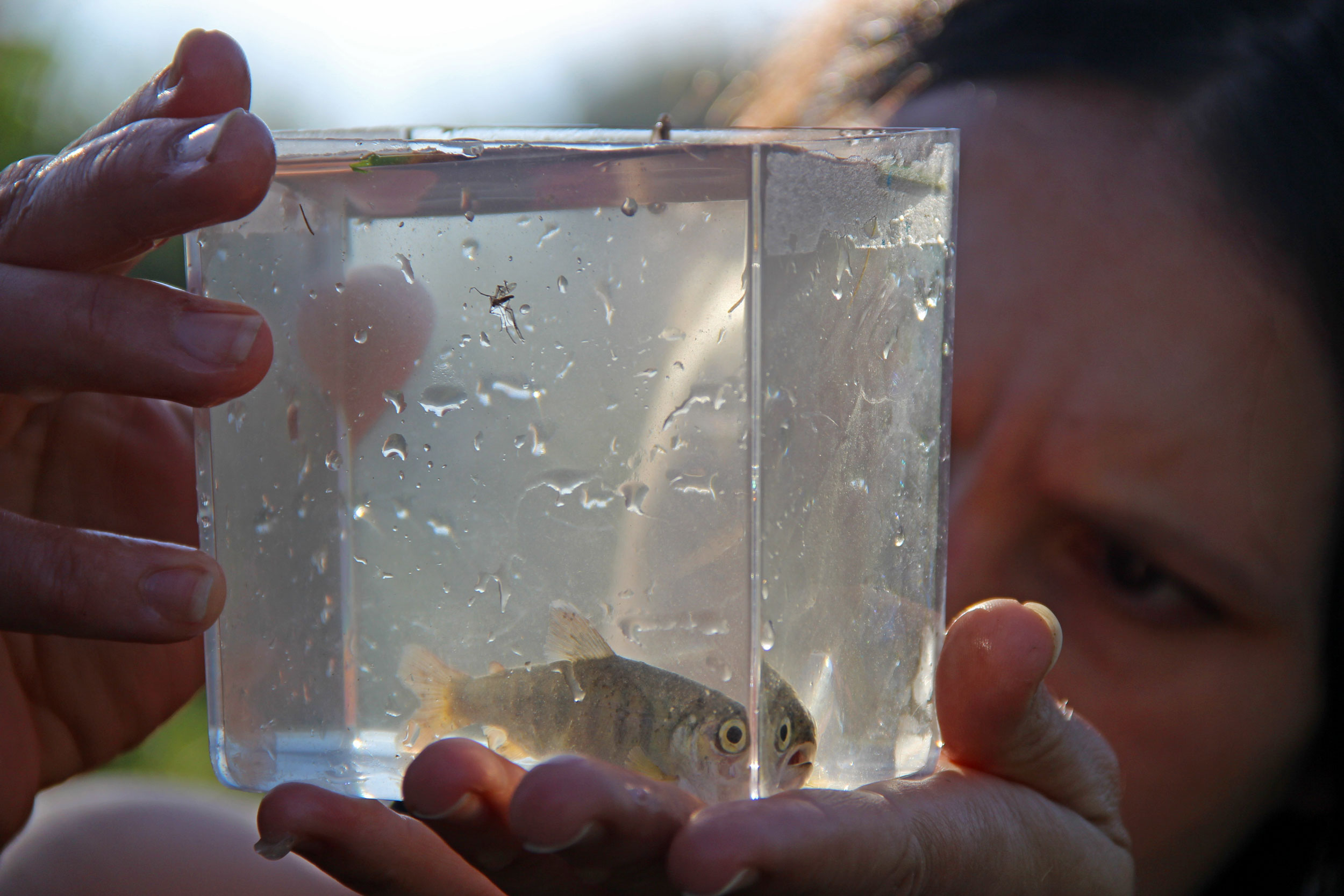


Danielle Zitomer, habitat biologist with the Washington Department of Fish & Wildlife, checks out a salmon fry from the Elwha River, a formerly dammed waterway now friendlier to fish thanks in part to intertidal beavers. Photo by Ben Goldfarb

“From our perspective,” Shaffer says, “they’re such an important link.”

These are boom times in the beaver restoration business. In arid ecosystems like Nevada and central Oregon, the rodents are increasingly perceived as hydrological saviors—capable of creating reservoirs for ranchers, dampening the spread of wildfire, and, by keeping streams cold and hydrated in the face of drought, even helping the warming West adapt to climate change.

Among coastal scientists, however, beaver fever has yet to spread beyond Greg Hood. He still has questions about the beaver’s intertidal role—in particular, how the organic matter trapped behind beaver dams flows through coastal food webs. “You’ve got these channels that are full of decaying leaves, sticks, and detritus, which tells you that we’ve got a lot more organic material and a lot more detritivores feeding off it,” he says. But studying those connections requires money, and grant-making institutions are little interested in funding research into a creature whose very presence is scarcely acknowledged.

To Hood, the paucity of attention suggests sampling bias. Beaver biologists focus on fresh water, where their subjects usually hang out. Coastal ecologists, meanwhile, gravitate toward sedge-filled lowlands, the dominant habitat in most Washington estuaries. As for the tidal shrub zone, that narrow, impregnable band of sweet gale and wild rose where beavers flourish and scientists fear to tread? It’s neglected—or it simply no longer exists, drained and diked and cleared by farmers a century ago. In the Skagit Delta, 95 percent of tidal shrublands have been destroyed.
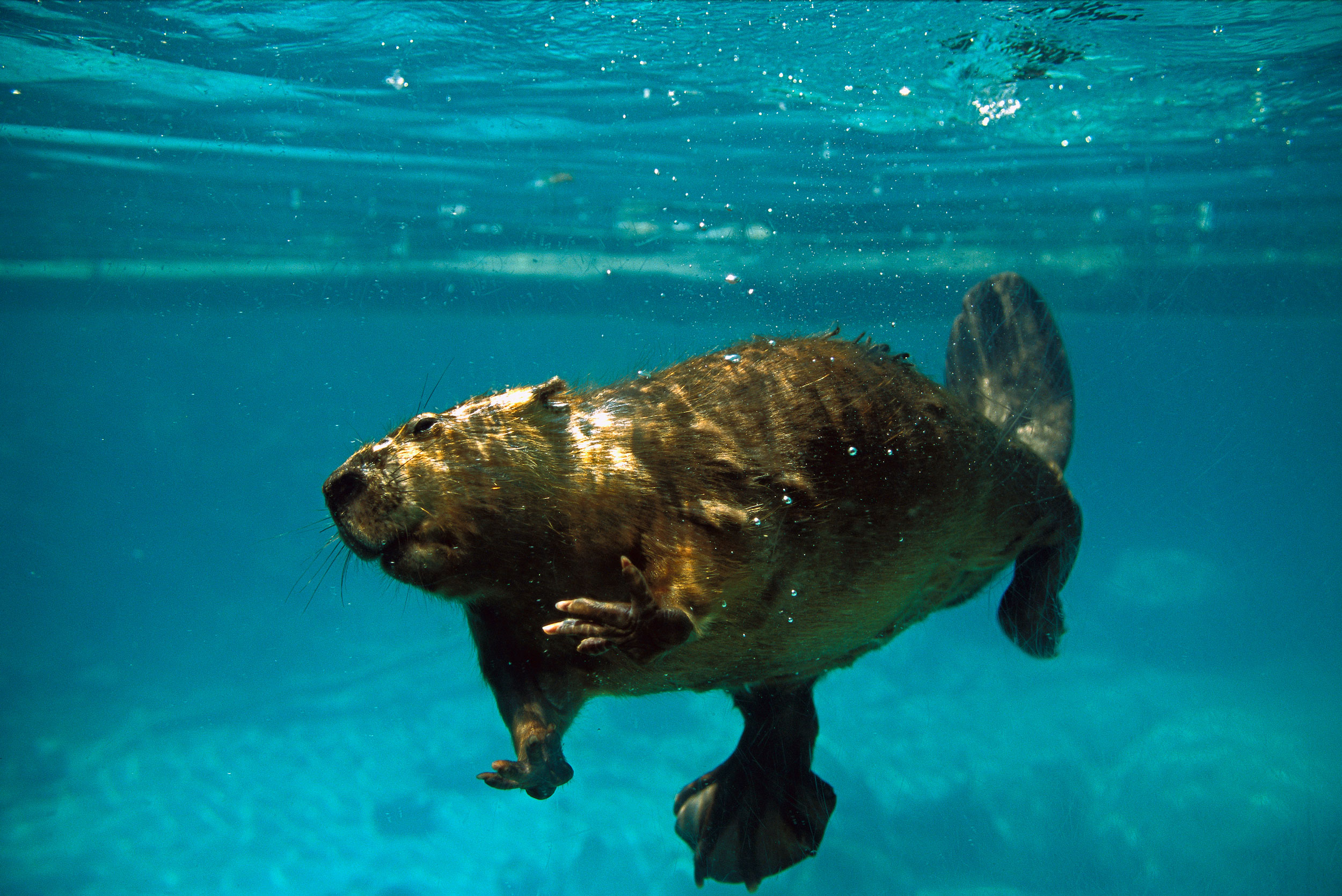


Beavers are semiaquatic rodents native to North America. Lately, scientists have come to recognize their important role in creating coastal fish habitat. Photo by Konrad Wothe/Minden Pictures

“It’s a rare habitat type, and people don’t spend much time in rare habitats,” Hood laments.

In a sense, then, our coastal beaver blind spot is an artifact of history—a form of “ecological amnesia,” as Frances Backhouse put it in her book Once They Were Hats. Just as sun-blotting flocks of passenger pigeons and earth-shaking herds of bison vanished from our skies and prairies, the combination of marsh drainage and trapping wiped beavers from our coastlines and, eventually, our memories.

“There are countless examples where we don’t know how ecosystems are supposed to work,” Hood says. “The landscape has been radically altered, and the way animals use the landscape has been radically altered.”

The estuaries of the Skagit, the Snohomish, and the Elwha are more than beaver bastions—they’re portals to a former paradise, a salmonid haven constructed and maintained by a passel of rodents. As for how those intertidal architects subsist in the salt—well, as Aldo Leopold once wrote of waterfowl, “What a dull world if we knew all about geese!” Some beavery mysteries, perhaps, are destined to remain unsolved.


Author bio


Ben Goldfarb is an environmental journalist whose work has appeared in Science, Mother Jones, Orion Magazine, The Guardian, and many other publications. He is the author of Eager: The Surprising, Secret Life of Beavers and Why They Matter. He’s also an angler, scuba diver, and nudibranch aficionado.


LINK: https://www.hakaimagazine.com/features/the-gnawing-question-of-saltwater-beavers/


Tuesday, April 30, 2019

Rescue Beaver Loves Building Dams In His House - JUSTIN BEAVER | The Dodo


Rescue Beaver Loves Building Dams In His House


Rescue Beaver Loves Building Dams In His House | This professional wildlife rehabber lets a baby beaver build dams in the house and swim in the tub 5 times a day. To sponsor the ongoing care of JB the beaver, you can support Brigette, his caregiver, at the Second Chances Wildlife Center: http://thedo.do/chances. Follow them on Facebook for his latest antics: https://www.facebook.com/secondchance....


Thursday, August 3, 2017

Owl


Beavers always look ready with a punchline


"Wood" you like to hear a joke?


Sunday, August 4, 2013

Archimedes' Secret (BBC Documentary)


Published on Nov 19, 2012


This is the story of a book that could have changed the history of the World. To the untrained eye, it is nothing more than a small and unassuming Byzantine prayer book, yet it sold at Christies for over $2m. For faintly visible beneath the prayers on its pages are other, unique, writings - words that have been lost for nearly two thousand years.

The text is the only record of work by one of the world's greatest minds - the ancient Greek, Archimedes - a mathematical genius centuries ahead of his time. Hidden for a millennium in a middle eastern library, it has been written over, broken up, painted on, cut up and re-glued. But in the nick of time scientists have saved the precious, fragile document, and for the first time it is revealing just how revolutionary Archimedes' ideas were. If it had been available to scholars during the Renaissance, we might have reached the Moon over a hundred years ago.

The trail begins in the tenth century, when a scribe made a unique copy of the most important mathematics that Archimedes ever developed. For 200 years the document survived, but the mathematics in it was so complex that no one paid it any attention. So when one day a monk was looking for some new parchment - an expensive commodity at the time - to write a new prayer book, the answer seemed obvious. He used the Archimedes manuscript. He washed the Greek text off the pages, cut them in half, rebound them, and turned the Archimedes manuscript into an everyday prayer book. As he piously wrote out his prayers, he had no idea of the genius he was obliterating.

Several hundred years later, the Renaissance was under way. Scientists were beginning to grapple with new concepts, working out how mathematics could be used to explain the World around them. Little did they know that many of the problems they were just encountering Archimedes had already solved more than a thousand years before. So, tragically, they had to do that research all over again, setting back the development of science and technology immeasurably.

Then in 1906, in Constantinople, the document mysteriously turned up in a monastic library. An opportunistic scholar called Johan Ludwig Heiberg identified the text as Archimedes' writings. Although the Greek text was very faint, Heiberg was able to decipher some of it. What he found astonished him, and made the front page of the New York Times. He revealed that Archimedes' manuscript contained something called 'The Method', which showed not only Archimedes' final proofs, but for the first time revealed the process of how he went about making his discoveries.


Category - Education
License - Standard YouTube License


Link:  http://youtu.be/giUk9leseBs


Saturday, May 25, 2013

Gnawing at nature in beaver country


By: Allen Abel


FAIRFAX COUNTY, Va. -- Northern Virginia's War of the Beavers pits human sprawl against Castor canadensis in a swampy morsel of fauna and flora surrounded by concrete, cars and money.
The setting is a miniature utopia called Huntley Meadows Park in privileged Fairfax County, half an hour south of the White House. This is a swampy second- and third-growth woodland choked with cattails. It is described, nevertheless, in a brochure available at the Visitor Center, as "a rich, natural island in the suburban sea."

The Big Pitcher

Though it harbours, as the pamphlet crows, "majestic forests, wildflower-speckled meadows and vast wetlands bursting with life," Huntley Meadows Park is not exactly Longfellow's forest primeval.

It has been, since colonial times, a fertile dairyland, the proposed site of the world's largest Zeppelin port, an asphalt test loop, a National Guard artillery base, and a Naval electronic espionage facility where towering antennae used to tune in nightly to Radio Moscow.

Today, with the Navy gone to sea, Huntley once again is home to dozens of species of locally uncommon birds, a flotilla of ironclad snapping turtles and so many deer that the county SWAT Team has to be brought in each winter to snipe at whitetails. (Though not at the Wilson's Snipe, which nests here.)

Meanwhile, those pesky beavers have run amuck -- messing with the water levels, felling oaks and hickories, and generally doing what they have been doing since the Middle Pleistocene.

"For an adult beaver, the only predator is the car," Huntley's director says, addressing a gathering of pro- and anti-beaverites.

(We are not unaware that, last summer, sisters aged eight and 11 were bitten by a rabid beaver while swimming in nearby Lake Anna. And we all have seen the recent headline from Belarus: Man tries to take photo of beaver; it kills him.)

The director is an amiable expert named Kevin Munroe who knows every rail and redbud in the park. It is his duty to explain to the people of Fairfax County why, after 21 years of bitter contention, a detailed Beaver Behaviour Study, and more than 60 public meetings, the park's stewards finally have decided to spend $3 million to turn Huntley's seasonal ponds into a gated community for North America's largest rodents.
This will involve the installation of a "Clemson Water Leveler System" comprising vinyl sheet pilings sunk three metres into a cordillera of lakeside mounds, sliding doors to keep the swamp in a perpetual state of "hemi-marsh," and underwater pipes with cages around them to keep the beavers from gnawing through the arteries of their own purported salvation.

"Duck farms," grouses a fellow in front of me.

"The beavers should have a seat at the table," another man seated behind me complains.

"The beavers would eat the table," I turn around and inform him.

"Do we really want to mess with nature?" Munroe asks us. "Because biodiversity is in decline, the answer is yes. We have damaged the natural ecosystem so badly, it is our duty to repair it."
A woman named Norma Hoffman is introduced to the meeting as a founder of the Friends of Huntley Meadows. She tells us that, one recent day, she was staffing the front desk when a morose young boy approached.

"Why are you so sad, Johnny?" she asked the lad.

"I didn't see an elephant," he sobbed.

So I ask Kevin Munroe: "Why don't you just put up a fence and bring in elephants?"

"Our goal is not necessarily to make visitors happy," he replies. "It is to re-educate people about local native habitat."
The meeting concludes and Munroe leads us out of the Visitor Center and along the boardwalk that leads to the beaver lodge. We see muskrats and several species of turtle, sliding through the broth, but no beavers. They are downstairs, tending to their kits.
"Twenty years ago, I would have said 'Protect, but don't manage,' " Munroe says. "I grew up reading The Lorax. I would have been the one standing across the gate to keep hunters from coming in to shoot the deer. That was a tough decision to make: You're going into a wildlife sanctuary to blow away Bambi?

"But we've seen invasive plants take over the forest and deer herds decimate the woodlands. Before Europeans came here, deer were controlled by wolves, by mountain lions, by Native Americans. How many of those do we have in Fairfax County now?"


"Is this the human future?" I ask him. "Tiny fragments of the so-called 'natural' world heavily managed?"
"The short answer is yes," he replies. Then he tells us that river otters have been spotted this spring in Huntley Meadows Park.

"River otters!" the audience clamours, exultant at the news.

"River otters eat baby beavers," says the naturalist, damming our joy.

"It's OK," says Kevin Munroe. "Circle of life."


Allen Abel is a Brooklyn-born Canadian journalist based in Washington, D.C.

Republished from the Winnipeg Free Press print edition May 11, 2013 J12


Source: http://www.winnipegfreepress.com/opinion/analysis/allen-abel-may-11-fyi-j12-207035191.html


Busy Beavers

Wednesday, July 18, 2012

New Baby Beaver Born On Alhambra Creek

New Baby Beaver Born On Alhambra Creek

 
Courtesy Worth-A-Dam

Local wildlife lovers are celebrating this week, heralding the arrival of a new addition to the Alhambra Creek beaver family.
A kit, estimated to be roughly six weeks old, was spotted by members of advocacy group Worth-A-Dam over the weekend, and founder Heidi Perryman said in a phone interview Monday that the youngster is now counted as the fifth current member of Martinez's Castor canadensis denizens.

Perryman said she first learned of a rumored beaver baby about a month ago, when an elementary school teacher from Pleasant Hill emailed her with news of a spotting from the Escobar Street bridge in early June. Since then, Worth-A-Dam members and supporters have been monitoring the downtown stretch of Alhambra Creek, hoping to catch sight of the elusive tot.

"First we saw the adults bringing in treats (into a newly-fashioned den, upstream from the Escobar Bridge)," said Perryman. "Then we saw Dad bringing in fennel ... fennel stimulates lactation so we wondered if there was a nursing mom in there."

It's been five years since a family of beavers set up housekeeping in the downtown waterway, sparking a civic uproar over a City Council plan to exterminate the aquatic rodents.

The original matriarch of the family died in 2010, after giving birth to 15 kits. Three of those kits have successfully reached near-adulthood, and in 2011, the patriarch left the creek for about four months. He returned with a suspected new mate, said Perryman, and she believes the newcomer has added another baby to the bunch.

On Sunday night, Perryman, her husband and another Worth-A-Dam member caught sight of the kit three times, and witnessed it attempt to give a forceful tail-slap, a beaverish sign of danger.

"He was clearly trying to be a beaver," said Perryman. The tail slap "took his whole body, he sort of fell into it."

Worth-A-Dam is hosting its fifth annual Beaver Festival on Aug. 4, and Perryman said "it's a great year to celebrate our beaver family."


 Source:
New Baby Beaver Born On Alhambra Creek
 http://www.martinezgazette.com

Beaver on the Highway


License:
Standard YouTube License

Beaver Expert Glynnis Hood


Watch live streaming video from ideacity at livestream.com


  • About This Presenter


    Glynnis Hood

    Dr. Glynnis Hood teaches Environmental Science. He research interests include aquatic ecology, beaver management and human-wildlife interactions.
Source:
Glynnis Hood ideaCity11on ideacity - live streaming video powered by Livestream
http://livestre.am/11Zy8

Sunday, July 15, 2012

Video - Beavers are Both Cute and a Niusance. WSJ's Joel Millman Reports on Beaver Relocation in Spokane - WSJ.com


Lifestyle

Relocation Program for Nuisance Beavers

The Beaver Solution Team live traps beavers on properties where they are causing damage and relocates them to places where they can chew up trees, build dams and help restore the water supply. WSJ's Joel Millman reports from Spokane.


 Link:
http://live.wsj.com/video/relocation-program-for-nuisance-beavers/FAD249C7-A28A-42BD-A3F1-C42BC4A1EBFB.html#!FAD249C7-A28A-42BD-A3F1-C42BC4A1EBFB

Video - Beavers are Both Cute and a Niusance. WSJ's Joel Millman Reports on Beaver Relocation in Spokane - WSJ.com

Monday, June 25, 2012

Robbie Burns: To A Mouse

A sculpture of a mouse in the garden of the Robert Burns Birthplace Museum, Alloway
 
 
TO A MOUSE
ON TURNING HER UP IN HER NEST WITH THE PLOUGH, NOVEMBER, 1785
by: Robert Burns (1759-1796)
      I
       
      EE, sleekit, cowrin, tim'rous beastie,
      Oh, what a panic's in thy breastie!
      Thou need na start awa sae hasty,
      Wi' bickering brattle!
      I was be laith to rin an' chase thee,
      Wi' murd'ring pattle!
       
      II
       
      I'm truly sorry man's dominion
      Has broken Nature's social union,
      An' justifies that ill opinion
      Which makes thee startle
      At me, thy poor, earth-born companion
      An' fellow-mortal!
       
      III
       
      I doubt na, whyles, but thou may thieve;
      What then? poor beastie, thou maun live!
      A daimen-icker in a thrave
      'S a sma' request;
      I'll get a blessin wi' the lave,
      And never miss't!
       
      IV
       
      Thy wee-bit housie, too, in ruin!
      Its silly wa's the win's are strewin!
      An' naething, now, to big a new ane,
      O' foggage green!
      An' bleak December's winds ensuin,
      Baith snell an' keen!
       
      V
       
      Thou saw the fields laid bare an' waste,
      An' weary winter comin fast,
      An' cozie here, beneath the blast,
      Thou thought to dwell,
      Till crash! the cruel coulter past
      Out thro' thy cell.
       
      VI
       
      That wee bit heap o' leaves an stibble,
      Has cost thee mony a weary nibble!
      Now thou's turn'd out, for a' thy trouble,
      But house or hald,
      To thole the winter's sleety dribble,
      An' cranreuch cauld!
       
      VII
       
      But, Mousie, thou art no thy lane,
      In proving foresight may be vain:
      The best-laid schemes o' mice an' men
      Gang aft a-gley,
      An' lea'e us nought but grief an' pain,
      For promis'd joy!
       
      VIII
       
      Still thou art blest, compared wi' me!
      The present only toucheth thee:
      But och! I backward cast my e'e,
      On prospects drear!
      An' forward, tho' I cannot see,
      I guess an' fear!
"To a Mouse" is reprinted from English Poems. Ed. Edward Chauncey Baldwin & Harry G. Paul. New York: American Book Company, 1908.

 Source:
 http://www.poetry-archive.com/b/to_a_mouse.html


 Portrait of Robert Burns 
 Robert Burns by Alexander Nasmyth
(By permission of the National Galleries of Scotland) 


Wednesday, February 1, 2012

An Ojibwa Legend

Once upon a time there was a beaver that loved to brag about his tail. One day while taking a walk, the beaver stopped to talk to a bird. The beaver said to the bird, "Don't you love my fluffy tail?" "Why, yes I do little beaver," replied the bird. "Don't you wish your feathers were as fluffy as my tail? Don't you wish your feathers were as strong as my tail? Don't you wish your feathers were just as beautiful as my tail?" the beaver asked. "Why do you think so much of your tail, little beaver?" asked the bird. This insulted the beaver and he walked away. After walking for a while, he stopped for a drink by the river and saw a muskrat. He walked to the muskrat and said, "Hello little muskrat. What do you think about my tail?" "Well, it is very beautiful and big and fluffy," answered the muskrat. "Is it also a strong tail?" "Why, yes it is," the beaver answered. "Do you wish you had a tail like mine?" "I didn't say I wanted a tail like yours. I just asked if it was strong," the muskrat replied with a disgusted voice. The beaver quickly turned and began walking back to his dam. He was angry because he felt that the animals were being rude to him. He was very upset and decided to take out his frustration by cutting down trees. After cutting down a couple of trees, he came to a very large one. He knew that it would be a great challenge for him. So he went to it. But as he was cutting, he kept thinking about his tail and didn't notice that he was cutting at a bad angle. Before he knew what was happening, the tree began to fall toward him. He jumped to get out of the way, but he didn't jump fast enough, and the huge tree fell on his beautiful tail! He tugged and pulled and finally dug away the earth to free himself. When he finally pulled his tail from under the tree, he was horrified to see that it was flat. The beaver was very sad and started to cry. As he was crying he heard a voice. It was the Creator. "Why are you crying?" asked the Creator. "A tree has crushed my beautiful tail," the beaver cried. "Now no one will like me." The Creator told him that a beaver is not liked for his tail but for his kindness and wisdom. He also told him how to use his flat tail. "Now your tail will help you swim rapidly," the Creator said. "And when you want to signal a message to a friend, all you have to do is slap your tail on the water." Hearing this made the beaver happy again. When the animals saw his flattened tail they were shocked! But the beaver said, "It's better this way." From that day on, the beaver never bragged about his tail, and all the animals liked him. That's how the beaver got his flat tail.

Monday, January 30, 2012

Baby Beaver


Beaver on the Highway

Your typical friendly Canadian. A beaver on the highway at the Canada US border, welcoming drivers to Canada. He got away fine (and he's not rabid!).


License:
Standard YouTube License

Friday, October 7, 2011

Patience is the beginning of Mindfulness


Patience is the companion of wisdom.

St. Augustine of Hippo (13 November 354 – 20 August 430)

(As quoted in Distilled Wisdom: An Encyclopedia of Wisdom in Condensed Form‎ (1964) by Alfred Armand Montapert, p. 270)

Monday, December 6, 2010

Beavers Eat Trees

Tuesday, November 2, 2010

The Hugh Cudlipp lecture


The Hugh Cudlipp lecture: Does journalism exist?


The full text of Guardian editor Alan Rusbridger's Hugh Cudlipp lecture

Alan Rusbridger
guardian.co.uk, Monday 25 January 2010 19.00 GMT
larger | smaller


Thank you for inviting me to give this lecture in honour of the memory of Hugh Cudlipp.


Ask any British journalist who were their editor-heroes over the last 30 or 40 years and two names keep recurring. One is Harry Evans. The other is Hugh Cudlipp.


Why were they so admired? Because they seemed to represent the best of journalistic virtues – courage, campaigning, toughness, compassion, humour, irreverence; a serious engagement with serious things; a sense of fairness; an eye for injustice; a passion for explaining; knowing how to achieve impact; a connection with readers. Even if you missed their editorships – as I did with Hugh Cudlipp – both men wrote inspiring books about journalism: about how to do it, but, more importantly, about why it mattered.


It is wonderful that Jodi Cudlipp is here tonight, though I hope she will not misunderstand me when I say a tiny part of me is quite glad Lord Cudlipp is not here in person. I believe he liked and admired the Guardian. But something tells me he did not enjoy being lectured by the Guardian.


He once wrote:


"The robust tabloids flashed the Green Light, were promptly denounced by other newspapers for their gaucherie or vulgarity or lèse majesté, and then were echoed by the very newspapers who had so severely upbraided them for their frankness."


He quoted Kingsley Martin, former editor of the New Statesman:


"The Mirror says openly only what the readers of the News Chronicle and the Guardian say behind their hands."


So I don't think Cudlipp would necessarily have enjoyed sitting through a lecture by the editor of the Guardian.


The one thing Cudlipp and Evans hardly ever wrote about was business models. For one thing, they didn't have to. They lived at an age where, if you got the editorial product right, money was usually not the burning issue. There was cover price and there was advertising and – though, of course, there were many newspaper failures along the road – there was no great mystery about where revenues came from. Secondly, they didn't see that as their job. Their job was to edit great papers: other people worked out how to pay for it.


Yet the most common question most editors are now asked is: "What's the business model?"


Of course, you know why people ask. Journalism may be facing a kind of existential threat. Whether you are a 22-year-old thinking about a career in journalism, or a 45-year-old wondering if your chosen calling will see you through to retirement, it's the question that nags away all the time. Insecurity is the condition of our journalistic age.


So it's a vital question. At the same time it's a kind of deadening question for journalists to be asking of other journalists. One – honest – answer is that no one can currently be sure about the business model for what we do. We are living at a time when – as the American academic Clay Shirky puts it – "the old models are breaking faster than the new models can be put into place".


And it's a bit deadening because journalists are, as a rule, better at thinking about journalism – including the most fundamental question of all, hinted at in my title tonight – of whether there is such a thing as journalism.


If you think about journalism, not business models, you can become rather excited about the future. If you only think about business models you can scare yourself into total paralysis.


Having said all that, I am going to begin tonight by talking about one business model – in part because it is even now coming down the slipway; in part because it so radically affects some of the most stimulating ideas of what journalism is becoming, or could become.


The business model is that one that says we must charge for all content online. It's the argument that says the age of free is over: we must now extract direct monetary return from the content we create in all digital forms.


Why I find it such an interesting proposition – one we have to ask, and which, typically, that great newspaper radical Rupert Murdoch, is forcing us to ask – is that it leads onto two further questions.


- The first is about 'open versus closed'. This is partly, but only partly, the same issue. If you universally make people pay for your content it follows that you are no longer open to the rest of the world, except at a cost. That might be the right direction in business terms, while simultaneously reducing access and influence in editorial terms. It removes you from the way people the world over now connect with each other. You cannot control distribution or create scarcity without becoming isolated from this new networked world.


- The second issue it raises is the one of 'authority' versus 'involvement'. Or, more crudely, 'Us versus Them'. Again, this is similar to the other two forks in the road, but not quite the same. Here the tension is between a world in which journalists considered themselves – and were perhaps considered by others – special figures of authority. We had the information and the access; you didn't. You trusted us filter news and information and to prioritise it – and to pass it on accurately, fairly, readably and quickly. That state of affairs is now in tension with a world in which many (but not all) readers want to have the ability to make their own judgments; express their own priorities; create their own content; articulate their own views; learn from peers as much as from traditional sources of authority. Journalists may remain one source of authority, but people may also be less interested to receive journalism in an inert context – ie which can't be responded to, challenged, or knitted in with other sources. It intersects with the pay question in an obvious way: does our journalism carry sufficient authority for people to pay – both online (where it competes in an open market of information) and print?


So I want to talk about those three forks today. They are not, I think, simply esoteric points about the choices facing one industry – newspapers. If, like Hugh Cudlipp, you believe that journalism actually matters, has some kind of moral purpose and effect, then these are decisions of great significance to society as a whole.


Which – before we think about business models – is probably a good moment to introduce the man who prompted the title of tonight's talk. Last autumn I was at a government seminar on the future of local newspapers when one of the participants suddenly interjected: "I don't believe in journalism."


This was a very direct challenge to my general worldview, not to mention my job, so I sought out the person who had made it – a very interesting man called William Perrin – a former Cabinet Office civil servant who threw it all in to run a hyperlocal websitereporting on the area of London where the Guardian now lives – King's Cross.


Perrin absolutely believes in the moral power and importance of what many of us might think of as journalism. But he isn't a journalist, he doesn't call it journalism and he is completely uninterested in the monetary value of what he does. He finds other ways to pay his mortgage. This is William Perrin:


.


William Perrin: "I set up a very simple website in 2006 … to my surprise this thing took off and has been very successful. In three or four years we have written 800 articles on King's Cross and area a mile long by half a mile wide …The website we have used to drive campaigns on the ground. We've run big campaigns against Network Rail, where we secured a million pounds for community improvements. We used the website again to take on Cemex, a multibillion-pound company … we took them on and we won. We have about four people who write for the site, on average, there's up to six, but normally there's about four of us writing. We all do it as a volunteer effort. It costs us about £11 a month in cash, which is about three of four pints of beer ... we have a very strong community of people around here who send us stuff. None of the people who work with me are journalists. I'm not a journalist by any stretch of the imagination; it's an entirely volunteer effort … Some people what I do in my community some people label journalism, it's a label I actually resist."


Depending on your point of view, you may find that vision of new ways of connecting and informing communities inspiring or terrifying. I think it is both – but it is a useful starting point to thinking about the value of journalism, in every sense of the word 'value'. And it is good to be forced to think at an even more basic level – about what journalism is and who can do it.


So, let's begin by thinking about this question of what the direct value of content is. It seems to be a subject on which no one can agree. Rupert Murdoch, who has in his time flirted with free models and who has ruthlessly cut the price of his papers to below cost in order to win audiences or drive out competition ("reach before revenue" as it wasn't called back when he slashed the price of the Times to as low as 10p) … this same Rupert Murdoch is being very vocal in asserting that the reader must pay a proper sum for content – whether in print or digitally. The New York Times announced last week that it would be reinstating a form of pay wall around its content. Casual readers will get the NYT for free. Repeat, or loyal, readers will be expected to pay.


At the other end of the spectrum we have millions of William Perrins, beavering away for free, not to mention a Russian oligarch and former KGB man, Alexander Lebedev, who is experimenting with giving away everything for free – in print and digital. He isjunking the one tried and tested revenue model of people handing over money for the printed paper. So there is no agreement among publishers, never mind the public, as to whether journalism has a direct value in any form.


Many people would like Murdoch and the New York Times to succeed – who could be against anything which could be relied on to support this thing which looks like journalism well into the future?


Now, I happen to believe that Rupert Murdoch is a brave, radical proprietor who has been a good owner of the Times and that he has often proved to be right when he has challenged conventional thinking. But many people who similarly admire him have nagging doubts about whether he's right this time. The publisher of the New York Times, Arthur Sulzberger Jr, admitted last week that his own pay wall proposals are, to some extent, "a bet". Full marks for honesty. What they're doing is a hunch.


To put it another way, it may be right for the Times of London and New York, but not for everyone. It may be right at some point for everybody in the future, but not yet. There is probably general agreement that we may all want to charge for specialist, highly-targeted, hard-to-replicate content. It's the "universal" bit that is uncertain.


Murdoch, being smart, knows better than most that a printed newspaper – a tightly-edited basket of subjects and articles – becomes a very different thing in digital form. He will know the argument that says that in future you may be able to charge for mobile, but not for desktops. That specialist information may have value, general information little or none. The arguments hardly need rehearsing tonight. We all know the Walmart-Baghdad subsidy theory – that it is retail display advertising that pays for the New York Times Iraq operation, not the readers.


On mobile, we're all at the start of an experiment that is fascinating but unknown. We had no clue what, if anything, to charge for the Guardian's iPhone app when we launched it at the end of 2009. We settled for £2.39 and sold 70,000 in the first month. It's one clue to the future, not an epiphany.


This year will see a fascinating struggle for dominance between the Kindle, the Sony reader, Plastic Logic's Que, the Skiff Reader and LG's 19-inch bendy e-journal. They may all have (if they don't already) significant revenue opportunities. Things are moving so fast that these remarks may be out of date by Wednesday, when Apple is expected to launch something between an iPhone and a Kindle.


That's mobile, where different rules may well apply. Universal charging brings different challenges. For universal charging to work, the argument goes, every news organisation would have to put all content behind a pay wall. One of the favourite Murdoch arguments against the BBC is that – so long as it exists and is "free" then that makes it harder for commercial news organisations to charge, James Murdoch describes what the BBC does as "dumping free, state-sponsored news on the market". The Murdochs would like the BBC to be drastically curtailed in order for their business model to have a better chance of success.


Now, Australians sometimes find it easier to speak bluntly to fellow Aussies than we Brits do. So I read with interest a recent speech by the head of the Australian Broadcasting Corporation – called "Media after Empire" – by their director general,Mark Scott.


The "empire" in his title was not the British Empire, but old media empires. He used his speech to rebut the notion that public broadcasting in Australia should have its wings clipped to prop old media models up. Yes, it's the same issue down under.


This is the speech you won't hear from Mark Thompson – or indeed anyone in British political or regulatory life:


"This old proprietorial model, long run by media barons, operated as a form of protection from harsh realities the business might otherwise have faced. They were still vastly profitable ... The barons worked a variation of the J Paul Getty formula for success: "Rise early, work hard, strike oil". TV, radio, newspapers were their oil … Media policy amounted to not much more than a tawdry chaos of compromises designed to appease these moguls."


"Today they seem largely out of solutions – and instead challenge reality by seeking to deny a revolution that's already taken place by attempting to use a power that no longer exists, [and] by trying to impose on the world a law that is impossible to enforce."


To Scott's way of thinking, newspaper companies are facing dreadful problems because – in his haunting phrase – "technology companies [have] continually outclassed the content companies".


"It would be wonderful to be able to present you with some blinding vibrant future for the old media organisations … For newspapers, the last great hope now seems to be something called Waiting for Rupert."


Scott's argument is it would be utterly wrong to hobble the one model that does successfully produce distinguished and serious news journalism – publicly-funded broadcasters – in order to sustain a failed business model.


A little digression about the BBC. I know it is regarded as an act of faith by some that all print journalists should be baying for BBC blood, wanting it neutered or drastically reduced. I find it difficult to join that particular chorus for three reasons.


Firstly, look across the water to America, where newspapers are in as much trouble as they are here. They have no public service broadcaster to speak of to contend with, and yet they are still in desperate trouble. So you could do an awful lot of damage to the BBC and still find you had not solved the problem of newspapers because it is actually a worldwide challenge, not a specifically British one.


Secondly, as a citizen rather than competitor, I'm afraid to admit that I really like, admire and respect the BBC – including, even, its website. Now, of course, there is plenty to criticise – the BBC can be arrogant, hard to work with, complacent, needlessly expansionist and insensitive to the plight of their colleagues in the commercial sector. We need to agree, or understand, the limits of its expansion. But the BBC is almost certainly the best news organisation in the world – the most serious, comprehensive, ethical, accurate, international, wide-ranging, fair and impartial. So I hesitate to join the sometimes deafening chorus of BBC denigration, even though I suspect the Guardian would undoubtedly thrive even better in the digital world were the BBC's website, in particular, to be curtailed.


Thirdly, there is another really excellent broadcaster with an irritatingly good news website – Sky News. I have seen nothing to suggest that there is any intention to put this website behind a pay wall. So, any British newspaper intending to charge for general content would have to contend – not only with the BBC – but with the free availability of a first rate Murdoch-owned general news service on the web. All the arguments about competition from a 'free' BBC online apply to a 'free' Sky News website.


So charging might be right for some bits of the Murdoch stable of media properties, but is it right for all bits of his empire, or for everyone else? Isn't there, in any case, more to be learned at this stage of the revolution, by different people trying different models – maybe different models within their own businesses – than all stampeding to one model?


One difference between the Murdochs and most other people is that they already have a digital business in this country – a highly successful and profitable one in Sky.


The Guardian is our digital business.


And it is a business, not a charity. The paper has always employed very talented and driven commercial people. The move from Manchester to London was a tough business decision as much as an editorial one – and how right that was. Our first decade of digital growth wasn't subsidised by the Scott Trust – it was relatively modest and covered by the profits of the paper.


And, before anyone makes the obvious point that we are trust-owned and loss-making, let me make the equally obvious point that all the Scott Trust does is to enable the Guardian to compete on the same more or less level playing field as a host of other loss-making papers, whether their own cross-subsidies come from large international media businesses, Russian oligarch billions or unrelated companies within the same ownership or group.


As 2009 ground on there was no shortage of digital sceptics who were ready to call time on the business of digital publishing – mainly on the grounds that search engine optimisation (SEO) was bringing in readers who didn't stay and who were hard to monetise.


There was something in their critiques. The indiscriminate chasing of numbers will do no good long term for any serious news organisation. And it is perfectly true that 2009 was a disappointing year for those who hoped for an unbroken pattern of growth in digital advertising.


But to dismiss the potential growth of digital right now – on the basis of the worst economic crisis since 1929 – may be a little premature.


Here's Sir Martin Sorrell, head of WPP, and one of the most influential figures in advertising anywhere in the world. He employs 140,000 people in 106 countries and takes $60bn a year in billings, with revenues of $14bn. He makes weather in advertising, the same way as Murdoch does in print.


.


"I would hope that within five years, so let's say 2013, or something like that, we would be at least one third in digital. We know that customers are spending 20% of time online. So if clients are spending 12% and consumers are spending 20% – and I've seen some evidence to suggest they are spending more than 20% – then there's a natural gravitational pull to 20% of the budgets being spent online … my guess is that when we get to a third of our business in 2014 we may very well want to up that percentage to 40% or even 50%."


Sorrell is not saying all this advertising is going to newspapers, and he has some sympathy for the pro-pay wall arguments. But he is signalling a steadfast belief that the digital share of the advertising cake is going to grow very sharply and significantly.


My commercial colleagues at the Guardian – the ones who do think about business models – are very focused on that, want to grow a large audience for our content and for advertisers, and can't presently see the benefits of choking off growth in return for the relatively modest sums we think we would get from universal charging for digital content. Last year we earned £25m from digital advertising – not enough to sustain the legacy print business, but not trivial. My commercial colleagues believe we would earn a fraction of that from any known pay wall model.


They've done lots of modelling around at least six different pay wall proposals and they are currently unpersuaded. They're looked at the argument that free digital content cannibalises print – and they look at the ABC charts showing that our market share of paid-for print sales is growing, not shrinking, despite pushing aggressively ahead on digital. They don't rule anything out. But they don't think it's right for us now.


So, having said I wouldn't talk about business models, I've said far too much. But that's because it's difficult to ignore this particular business model in talking about how the future of journalism is shaping up.


As an editor, I worry about how a universal pay wall would change the way we do our journalism. We have taken 10 or more years to learn how to tell stories in different media – ie not simply text and still pictures. Some stories are told most effectively by a combination of print and web. That's how we now plan our journalism. As my colleague Emily Bell is fond of saying we want it to be linked in with the web – be "of the web", not simply be on the web.


Some stories can be told in one sentence plus a link. Some journalists are fascinated by the potential of the running, linked blog. Andrew Sparrow's minute by minute blog of Alastair Campbell's appearance before the Chilcott inquiry was a dazzling example of this new form of reporting, which relies on the ability to link out to sources and other media, including original documents and even (in the lunch break) Campbell's own Twitter feed.


You can see journalists everywhere beginning to get all this.


Ruth Gledhill at the Times is, for me, an inspired example of how you can layer reporting – with the most specialist material in the blog (linked to yet more specialist source material on the web – and the most general material in newsprint.) The paper will carry a paragraph on a controversial sermon by the Bishop of Chichester. Gledhill will explain its significance on her blog, and link to the full sermon for those who want the source. Readers can then debate the text on the blog and follow other links. It's called through-editing.


Ben Brogan does something similar at the Telegraph, as he did in pioneering form at the Mail previously. Robert Peston and Nick Robinson increasingly regard their blogs as the spine of what they do at the BBC. That's where they put the detail: the Ten O'Clock News is the icing.


This, journalistically, is immensely challenging and rich. Journalists have never before been able to tell stories so effectively, bouncing off each other, linking to each other (as the most generous and open-minded do), linking out, citing sources, allowing response – harnessing the best qualities of text, print, data, sound and visual media. If ever there was a route to building audience, trust and relevance, it is by embracing all the capabilities of this new world, not walling yourself away from them.


Two further points about this fluid, constantly-iterative world of linked reporting and response: first, many readers like this ability to follow conversations, compare multiple sources and links. Secondly, the result is journalistically better – a collaborative-as-well-as-competitive approach which is usually likely to get to the truth of things, faster.


When I think about universal pay walls, I wonder how this emerging world of editing and writing would change. How would you handle a story like the Guardian's exclusive revelation that Google was about to drop censorship in China – a hugely significant story that bounced around the world within seconds of us breaking it online at 11pm on January 12?


Had there been a universal pay wall around the Guardian that would have been a difficult story to handle.


- Wait and publish in print? But we knew that Google was about to post the story on its own blog at 6pm Eastern.


- Publish digitally and hope that people would buy a day pass to read it? But in the time it took to key in your credit card the essence of the story would have been Twittered into global ubiquity. It is one of the clichés of the new world that most scoops have a life expectancy of about three minutes. A valuable three minutes for the FT or the Wall Street Journal if it's market sensitive information. Most people, with most information, and without subscriptions paid for by their companies, are happy to wait.


If you erect a universal pay wall around your content then it follows you are turning away from a world of openly shared content. Again, there may be sound business reasons for doing this, but editorially it is about the most fundamental statement anyone could make about how newspapers see themselves in relation to the newly-shaped world.


The internet has, of course, has had a dramatic impact on the economics of newspapers. But it has changed almost everything else as well. The whole world is in the middle of a revolution. This may sound an old-fashioned thing to say, because it has been true for at least 10 years. Things are still changing overwhelmingly and fast; in part, because the first digital generation is still growing up.


There's been one change so big and obvious in the last decade that we may not have noticed it: the new media have disappeared. They are just media now: the means through which our world must be experienced. No one under 25 can remember a world without them. Everything shows up on screens, from the big ones we sit in front of all day at work to the small ones on the phones with which we spend our leisure hours – when they're not sending us emails.


These screens give us very much more than written words, and they change the ways we understand the world – from text to multimedia; from linear to hypermedia; from passively absorbing material to learning how to navigate actively – and we change them right back.


Don Tapscott, in his book Growing Up Digital, has explored some of the ways in which the technologies of the last 20 years have helped develop a generation of fierce independence; of emotional and intellectual openness; of inclusion; biased towards free expression and strong views; interested in innovation, used to immediacy; sensitive to/ suspicious of corporate interest; preoccupied with issues of authentication and trust – which includes having access to sources; interested in personalisation or customisation rather than one-size fits all; not dazzled by technology, but more concerned with functionality.


In the digital world, the distance between impulse and action is shorter than ever before. The goal of most interface design is to make it vanish altogether. In this open and immediate world millions of people are realising they can be publishers, that they don't need intermediaries. The British Museum or the Tate or the Royal Society or Imperial College don't have to wait any longer for the BBC or Channel 4 to ring and suggest a programme or series; they can make their own. The same is true of any writer, scientist, politician, photographer or activist. To call this the "democratisation of communication", or of information, or of culture seems somehow inadequate.


Governments are freeing up their data, records and information; museums and galleries are throwing open their doors; NGOs and charities are becoming publishers; universities are opening their lecture halls; scientists and corporations are sharing knowledge in ways which would have been unimaginable even 10 years ago. And then there is Google, with its ambition to digitise and organise all human knowledge since time began.


Mention Google, and we think of China: the spread of disorganised information is balanced by organised disinformation and censorship. We can't know yet who will win, but we know what side we must be fighting on.


We know that the fastest – almost vertical – growth in amongst all this is what is rather lumberingly called 'social media'. This involves the power to generate content and connect with others at low, or no cost; in real time. The innovation that made all this possible – crudely, developments associated with Web 2.0 – is now happening alongside the evolution of so-called semantic web, which wants to find better ways of understanding the meaning of content and how to find it, organise it and share it.


Where do news organisations think they fit into all this? Are we in, out – or in only if we can make it pay in the immediate future?


I try to imagine the Guardian deciding it doesn't want openly to be part of this world I've just described and I struggle. And do, please, forgive me for talking about the Guardian a bit, but it is necessarily the thing I am most focused on, and which illustrates the point that one size may not fit all.


The other day I interviewed the playwright Michael Frayn for the Guardian and Observer archive. He described life on the Manchester Guardian he joined in 1957 – just over 50 years ago, but within one working lifetime.


The paper he joined was still a provincial morning paper, hugely influential, but not always readily available on the day outside the north-west and parts of London, Oxford and Cambridge.


This ledger shows the sale of the Manchester Guardian in and around Manchester in January 1956 – the year before Frayn joined the paper.


The Guardian's Manchester sales in 1956


It was a paper which counted every sale in Rusholme, Didsbury or Cheetham Hill.


Today, in print, the Guardian is, even now, the ninth or 10th biggest paper in Britain.


On the web it is, by most measurements, the second best-read English-language newspaper in the world. If the New York Times really does start charging for access, the Guardian may become the newspaper with the largest web English-speaking readership in the world.


In December the journalism we're producing at GNM was read by 37 million people around the world – very roughly a third in the UK, a third in North America and a third in the rest of the world.


Go back to the 1956 Manchester Guardian ledger of sales outside Manchester, the paper Frayn joined.
The Guardian's sales outside Manchester in 1956 


The Guardian's sales outside Manchester in 1956


The last line shows the worldwide sales of the Guardian – "foreign agents" – to be 650 copies. We had more readers in Colwyn Bay than in the rest of the world.


This clever little widget is effectively our digital circulation map today. It shows you in real time a sample of the people reading the Guardian from just one of its 32 servers.


In Michael Frayn's professional working life the Guardian has grown from sending 650 copies abroad to becoming one of the eight most read newspapers in the world, a ranking that includes two Chinese, one Japanese and one South Korean.


I think back to an essay CP Scott – for 57 years editor of the Guardian – wrote in 1921 – not the famous essay on the separation of comment and fact – but the preface to the American edition of the centenary history of the Manchester Guardian.


"The world is shrinking. Space is every day being bridged. Already we can telegraph through the air or the ether, from Penzance to Melbourne and tomorrow we shall be able to talk by the same mechanism. Physical boundaries are disappearing … What a change for the world! What a chance for the newspaper!"


Scott would, I think, have been intensely intrigued to know that the paper he edited for so long and in whose name a family trust was established to continue the spirit of the Guardian – was so openly available and read around the world. That it was becoming as influential in Beijing and Washington as in Paris or Delhi. That its reporting could change the minds of governments, inspire thinking, defy censorship, give a voice to the powerless and previously voice-less. The same is true of all the British newspapers who have grasped the importance of the web.


It's certainly a powerful thought for journalists on all these papers. Reporters and commentators who were digital sceptics even a couple of years ago now realise they are part of, and linked to, a worldwide conversation. An art critic will be picked up and referenced in Berlin; a defence correspondent in Moscow; an environment writer in Copenhagen. Tell them their work was about to disappear from that conversation without the production of a credit card, and they would not be overjoyed unless they knew it was the only answer in business terms.


In an industry in which we get used to every trend line pointing to the floor, the growth of newspapers' digital audience should be a beacon of hope. During the last three months of 2009 the Guardian was being read by 40% more people than during the same period in 2008. That's right, a mainstream media company – you know, the ones that should admit the game's up because they are so irrelevant and don't know what they are doing in this new media landscape – has grown its audience by 40% in a year. More Americans are now reading the Guardian than read the Los Angeles Times. This readership has found us, rather than the other way round. Our total marketing spend in America in the past 10 years has been $34,000.


Nor is all this being bought by tricks or by setting chain-gangs of reporters early in the morning to re-write stories about Lady GaGa or Katie Price. In that same period last year, our biggest growth areas were environment (up 137%), technology (up 125%) and art and design (up 84%). Science was up 81%; politics 39% and Comment is Free 38%.


This is the opposite of newspaper decline-ism, the doctrine which compels us to keep telling the world the editorial proposition and tradition we represent are in desperate trouble. When I think of the Guardian's journey and its path of growth and reach and influence my instincts at the moment – at this stage of the revolution – are to celebrate this trend and seek to accelerate it rather than cut it off. The more we can spread the Guardian, embed it in the way the world talks to each other, the better.


And that leads to the third fork – the one that pitches authority against involvement, or Us against Them.


Have a look at this website, recently launched, which aims to do for books what Facebook has done for general social engagement.


Bookarmy is a rather clever site – completely free – where, once you've registered, you can share your passion for books with thousands of others. You can join forums around types of books, or individual books. You can have virtual discussions with authors, link your reading group to others, publish your own reviews and so on. Apart from the authors themselves, there are no "authority" figures here.


Compare it with, say the Times books pages. Here the reverse is true: the emphasis is on "expert" reviews by critics, with not much interest in what you might have to say about a particular book. There is a kind of book group, but you would have to say that interactivity is not the feature it most promotes.


Why am I comparing these two sites? Because both are owned by Rupert Murdoch.


BookArmy – though it avoids saying so – is an offshoot of Harper Collins. The two enterprises point in completely different directions. As it was explained to me, the point of BookArmy is to get as many avid book readers engaged as possible and learn as much as possible about their likes and dislikes. At some point in the future (the theory goes) publishers will no longer need to spend a fortune on marketing Max Hastings' next book by lavishing money on Waterstones or in print. They will go to BookArmy and say "We know you have a database of the 80,000 people in the country who read books of military history. We'll give you our targeted marketing spend instead."


BookArmy is a telling illustration of two aspects of the digital world.


- One is the ability of digital disrupters (in this case, even within the same company) to take one bit of a newspaper and do it with a conviction, range, depth and passion that a portmanteau print-based newspaper cannot match, especially in digital form. It is the unbundling of newspapers.


- And the second is the only hope of matching the power of the these digital disrupters is to harness the same energy and technologies which they are using.


So, all credit to the Murdoch empire: they are themselves beavering away to unbundle parts of the print world in digital. How should other papers which care about books react? Sit behind a pay wall while the audience is unbundled for us by the make-it-free bit of the Murdoch empire? Or get out there and have a chance of being part of the way the rest of the world is going?


If you still want convincing look at this site, the Artsdesk, on which a lot of arts writers who used to work for the national press have set up their own culture site. That's right, they want to unbundle the arts coverage from newspapers. I imagine they begin each day with a prayer session for all national newspapers to follow Rupert Murdoch behind a pay wall. That's their business model.


We know about the audience for social media forms of engagement – 350 million active users on Facebook, 2.5bn pictures posted a month; Twitter growing at 400% a year. We know people spend much more time with such sites than with newspaper websites.


Now, of course, lots of journalists find this hard to take. We are supposed to be the ones in the know, or with special access or insights. "Social media is interesting," say the digital sceptics, "but it may be transient – and it has got nothing to do with what we do. Our brands are about authority."


But this position – that journalists are uniquely knowledgeable and insightful – is a hard one to sustain to anyone who looks at the blogosphere with an open mind, or looks at the astonishing way in which a tool like Twitter can be customised into a personalised news feed to give you extraordinarily rich and deep content on specialised subjects faster (and in many cases deeper) than any newspaper could hope to match.


Does all this mean you sack Michael Billington, with his 39 years of experience, and ask all the Guardian readers in the National Theatre audience to tweet their reviews in 140 characters or less?


No – but you could keep both.


Many of the Guardian's most interesting experiments at the moment lie in this area of combining what we know, or believe, or think, or have found out, with the experience, range, opinions, expertise and passions of the people who read us, or visit us or want to participate rather than passively receive.


There have been long-standing innovations such as Travel – where the experiences of readers, properly harnessed, is necessarily going to be broader, deeper and more eclectic than any us-to-them travel section based solely on the individual experiences of travel writers. 433 views of Amsterdam, rather than one.


There has been over-by-over cricket – not replacing Mike Selvey or Vic Marks, both of whom played for England and know a thing or two, but adding the enthusiasm, passion and graveyard humour of cricket-loving Guardian readers to the blogging of Rob Smyth or Andy Bull.


There is Comment is Free – infinitely more diverse, wide-ranging and, at its best, enlightening than any newspaper ever achieved by simply pushing the opinions of a few columnists out of the door and slamming it shut.


The last year has seen us crowd-source tax-avoidance – the internal Barclays documents that can (after a legal fight) be found on Wikileaks and whose publication undoubtedly led to changes in legislation and attitudes to corporate tax avoidance. It began with a traditional piece of investigation by David Leigh, followed by participation and analysis by people who really understood this world. It was classically an example of "our readers know more than we do" – the bit of new media theory which seemed so daring when first aired by Dan Gillmor in 2004.


There have been other examples of crowd-sourcing:


- The G20 protests – another example where old fashioned reporting was allied with the mass observation of people we wouldn't call reporters, but who were, on the day, able to do acts of journalism. The truth about the death of Ian Tomlinson probably wouldn't have been uncovered without the doggedness of one reporter – Paul Lewis – but it certainly wouldn't have emerged without thousands of people searching their own digital record of the day for the crucial evidence.


- There was the widget we built to allow 23,000 Guardian readers to help us sort through hundreds of thousands of documents relating to MPs expenses. The Telegraph's original investigation was brilliantly executed. But the future will also be about asking for help in digesting vast and complex amounts of data.


- There was the exercise of asking readers to get to the bottom of Tony Blair's tax affairs– expertise which did not lie within our own offices and which could have cost many thousands of pounds to buy in.


There has been Twitter and the way individual journalists have used it to draw on the expertise of specialist followings. Significant communities building around reporters or subjects – 1.5 million and counting who have chosen to follow the Guardian's technology team. The most enterprising reporters are learning how to use Twitter to research; as a customised, specialised, personalised wire service; to break news; to market and distribute content; to build communities and bring them into the Guardian.


There was the Guardian's environmental site – something we went into knowing we couldn't possibly do such a huge and complex subject on our own. So we joined up with a network of environment sites and bloggers. We link to them; they link to us. We give them a platform and deliver a large audience (and a share of advertising). They give us a diversity and range we could not hope to achieve ourselves. It's difficult, in our industry, to argue with 137% growth.


And there was Trafigura. Again, this started as a piece of conventional reporting by David Leigh (not forgetting the BBC, and colleagues in Norway and the Netherlands). They uncovered a truly shocking story about a company which had hitherto been comfortably anonymous and which wanted to keep it that way.


After dumping toxic waste in the Ivory Coast Trafigura was hit with a class action by 30,000 Africans who claimed to have been injured as a result. The company employedCarter-Ruck to chivvy journalists into obedient silence and then, having secured the mother of all super-injunctions, made the mistake of warning journalists that they could not even report mentions of Trafigura in parliament.


One tweet and that legal edifice crumbled.


This animated map of what the Twitterati were discussing, or searching for, showed how – within 12 hours of my tweeting a suitably gnomic post saying we had been gagged – Trafigura became the most popular subject on Twitter in Europe.


Some tweeters beavered away trying to find out what it was they were banned from knowing. One erudite tweeter uncovered something called the 1840 Parliamentary Papers Act, which no media lawyers seem to know about. Others pointed to where a suppressed document was available. Others found and published the parliamentary question we were warned not to report.


Within hours Trafigura had thrown in the towel on the injunction and dropped any pretence that they could enforce a ban on parliamentary reporting. The mass collaboration of strangers had achieved something it would have taken huge amounts of time and money to achieve through conventional journalism or law.


These examples show how – so long as it is open to the rest of the web – a mainstream news organisation can harness something of the web's power. It is not about replacing the skills and knowledge of journalists with (that ugly phrase) user generated content. It is about experimenting with the balance of what we know, what we can do, with what they know, what they can do.


We are edging away from the binary sterility of the debate between mainstream media and new forms which were supposed to replace us. We feel as if we are edging towards a new world in which we bring important things to the table – editing; reporting; areas of expertise; access; a title, or brand, that people trust; ethical professional standards and an extremely large community of readers. The members of that community could not hope to aspire to anything like that audience or reach on their own; they bring us a rich diversity, specialist expertise and on the ground reporting that we couldn't possibly hope to achieve without including them in what we do.


There is a mutualised interest here. We are reaching towards the idea of a mutualised news organisation.


To end where we began: Hugh Cudlipp does not feel to me like an editor who would have wanted to cut himself off from a revolution such as we're living through. He feels like someone who would have seized on today's technological opportunities to embrace the Mirror readership – just as he did with the Mirror's Live Letters. He lived by the credo – when in doubt, ask the readers.


One of his favourite Mirror front pages came at the height of the controversy over whether Princess Margaret should be allowed to marry Group Captain Peter Townsend, who, as well as being a Battle of Britain hero, was also a divorced man. One Monday in July 1953 the Mirror put the question to its readers, with a voting form on the front page which, in pre-Twitter days, readers had to cut out, stick in an envelope, attach a stamp and post.


By Friday 70,000 Mirror readers had responded, with a 97% vote in favour of Margaret being allowed marrying Townsend.


The sequel – nine days later – was a rap over the knuckles by the Press Council – "strongly deprecating as contrary to the best traditions of British journalism the holding by the Daily Mirror of a public poll in the matter of Princess Margaret and Group Captain Townsend." The following day the Mirror led on Lord Beaverbrook denouncing this "smug, pompous resolution" and itself describing the censure as "ridiculous".


So newspapers criticising self-regulators isn't new either.


Yes, there are lots of concerns about this world I'm describing, not least the ignorant, relentlessly negative, sometimes hate-filled tone of some of what you get back when you open the doors. That can sometimes feel not very much like a community at all, let alone a community of reasonably like-minded, progressive intelligent people coming together around some virtual idea of the Guardian. So there are a throng of issues around identity, moderation, ranking, recommendation and aggregation which we – along with everyone else – are grappling with.


But let's grapple with them rather than dismiss them or turn our backs on them. Let's not leave the field so that the digital un-bundlers can come in, dismantle and loot what we have built up, including our audiences and readers. "Comment is Free" ... "Publish and be Damned" … Fleet Street is the birth place of the tradition of a free press that spread around the world.


There is an irreversible trend in society today which rather wonderfully continues what we as an industry started – here, in newspapers, in the UK. It's not a "digital trend" – that's just shorthand. It's a trend about how people are expressing themselves, about how societies will choose to organise themselves, about a new democracy of ideas and information, about changing notions of authority, about the releasing of individual creativity, about an ability to hear previously unheard voices; about respecting, including and harnessing the views of others. About resisting the people who want to close down free speech.


As Scott said 90 years ago: "What a chance for the newspaper!" If we turn our back on all this and at the same time conclude that there is nothing to learn from it because what 'they' do is different – 'we are journalists, they aren't: we do journalism; they don't' – then, never mind business models, we will be sleep walking into oblivion.

guardian.co.uk © Guardian News and Med